
Guide to mixMIX: the key to optimise traffic signal settings for mixed flow with motorbikes.
- First Print: October 13, 2016
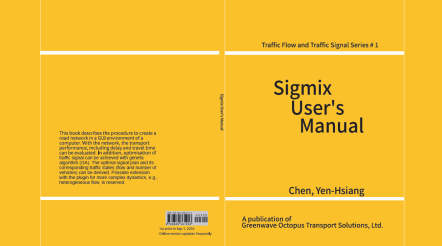
- Publisher: Greenwave Octopus Transport Solutions, Ltd.
- 62 pages
- ISBN: ISBN 978-986-93619-1-0
- DOI: 10.13140/RG.2.2.21299.73760
- Full Text (updated versions): Downloads
- Full Text (with cover, updated version in Nov. 2017): Guide to mixMIX
The current state-of-the-art software package is able to optimise off-line traffic signal in road networks, yet without certain features in countries with a significant number of motorbikes. If motorbikes (scooters) are not properly modelled, the performance difference between modes, dynamics of the heterogeneous flow, and accuracy of the result are not accounted. To cope with the issue, modelling heterogeneous flow is required. Then, the model is able to be applied in finding optimal traffic signal settings. This book introduces how to operate mixMIX, which can simulate mixed flow traffic with motorbikes in macroscopic manner and find optimal traffic signal settings. The structure of mixMIX, which is a plug-in of software Sigmix, and its running model are introduced. Then, operation in detail is demonstrated. Examples are shown how to apply mixMIX to investigate traffic, especially the mixed flow traffic, which has a much more complex dynamics than car-only traffic.



 Greenwave Octopus